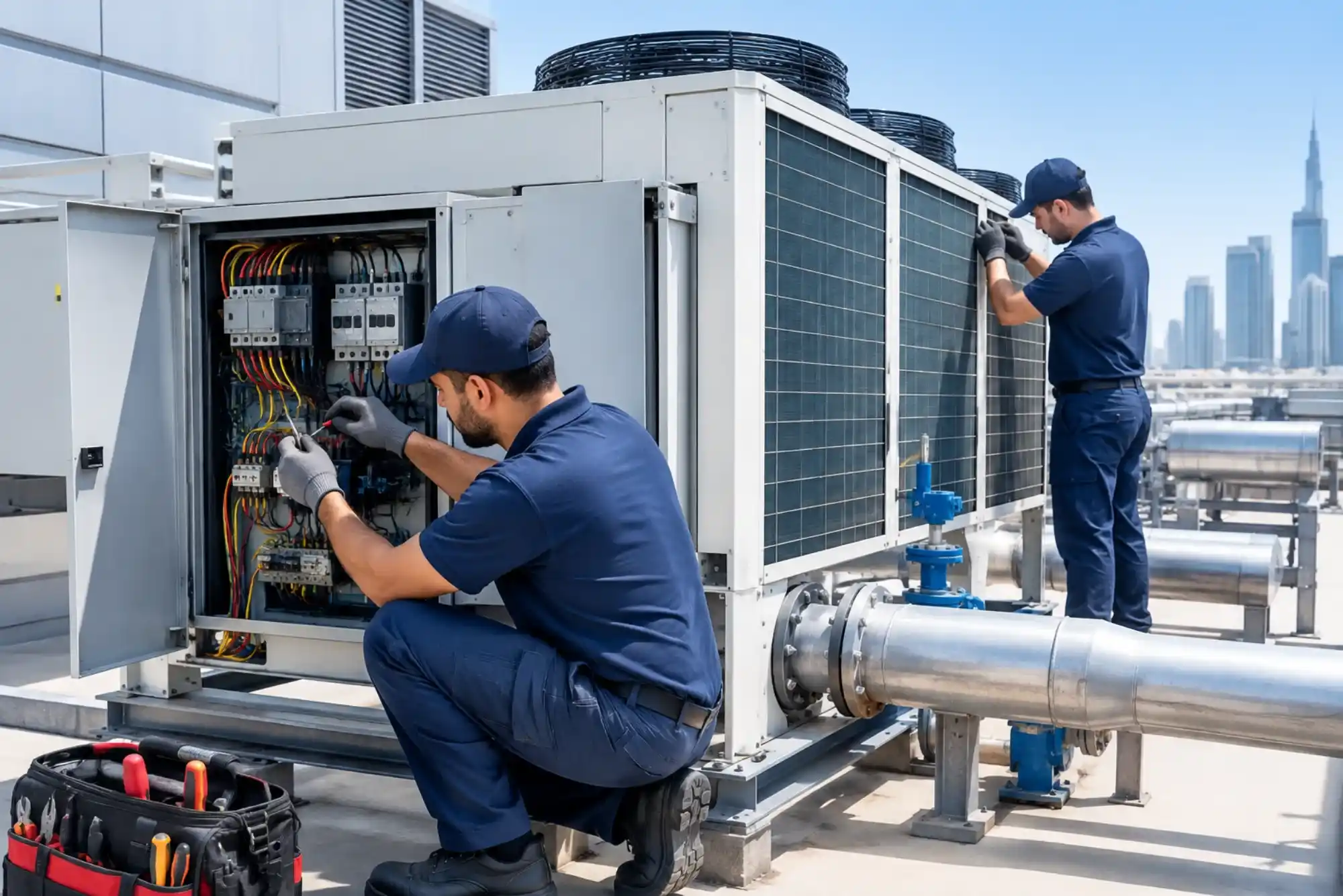
Choosing Commercial Cooling Experts in Dubai
The Best Commercial Cooling System Repair And Maintenance Experts are service professionals who can assess the complete cooling system, identify faults accurately, perform appropriate repairs, and maintain equipment according to the building’s operational requirements. For commercial properties in Dubai, selection should be based on technical scope, inspection practices, documentation, safety procedures, maintenance capability, and the provider’s ability to work with the type of HVAC equipment installed.
Commercial cooling can involve air-handling units, condensing units, chillers, cooling towers, coils, controls, ventilation equipment, and air-distribution systems. ASHRAE Standard 180 specifically establishes minimum inspection and maintenance requirements for commercial building HVAC systems, with objectives including thermal comfort, energy efficiency, and indoor air quality.
Dubai also has its own building-code framework. Dubai Municipality states that the Dubai Building Code establishes minimum requirements relating to building health, safety, welfare, environmental considerations, and sustainable development, and it provides specific HVAC-related schedules and calculations.
For this reason, “best” should not mean a universally superior company. It should mean a commercial cooling service provider that matches the building, equipment, maintenance requirements, and documented scope of work.
What Commercial Cooling System Repair And Maintenance Covers
Commercial Cooling System Repair addresses equipment that is malfunctioning, underperforming, leaking, making unusual noise, failing to maintain the required indoor conditions, or producing other observable symptoms.
Commercial Cooling System Maintenance is different because it is planned work intended to preserve system condition and operating capability. ASHRAE describes preventive maintenance as an approach designed around proper operation, with durability, reliability, efficiency, and safety among its principal objectives.

Depending on the installation, commercial HVAC work can involve:
-
Air-handling units and air distribution
-
Air-cooled and water-cooled chillers
-
Condensing units
-
Cooling coils and radiators
-
Cooling towers
-
Control systems
-
Filters and ventilation components
-
Thermostats, sensors, and other control equipment
-
Condensate-management components
-
Ductwork and air-distribution components
ASHRAE Standard 180’s published equipment categories specifically include air distribution systems, air handlers, air-cooled and water-cooled chillers, coils, condensing units, control systems, and cooling towers.
The exact work required depends on the equipment design and the fault identified during inspection.
How Commercial HVAC Repair Works in Practice
A professional Commercial HVAC Repair Services process should begin with diagnosis rather than immediately replacing components.
The technician first needs to understand the reported symptom and inspect the relevant equipment. Depending on the system, this can involve checking operating conditions, controls, airflow, temperature-related measurements, electrical components, mechanical components, filters, coils, condensate arrangements, and other system-specific elements.
Commercial Cooling System Inspection
A Commercial Cooling System Inspection provides the information needed to determine whether the issue is isolated to one component or connected to a wider system problem.
For example, inadequate cooling may involve an equipment fault, airflow restriction, control problem, coil condition, refrigerant-system issue, or another underlying cause. A visual symptom alone does not establish the exact cause.
ASHRAE’s commercial HVAC maintenance framework includes inspection and maintenance requirements covering multiple equipment categories rather than treating every cooling installation as the same system.
Commercial HVAC Troubleshooting
Commercial HVAC Troubleshooting should therefore follow the equipment manufacturer’s technical requirements and the building’s operating documentation where available.
A useful service report should distinguish between:
-
Reported symptom
-
Inspection findings
-
Identified fault
-
Recommended corrective action
-
Parts or components requiring attention
-
Work completed
-
Additional work recommended
-
Any relevant testing or measurements
This documentation makes it easier for a facility manager to understand what was actually found instead of receiving only a general statement that the system “needs repair.”
Commercial Cooling Maintenance in Dubai
Commercial HVAC Maintenance should be planned around the actual equipment and operating conditions rather than treated as a generic cleaning visit.
ASHRAE identifies Standard 180 as a framework for commercial HVAC inspection and maintenance, while its technical guidance also points facility professionals toward maintenance documentation and ventilation requirements.
Commercial HVAC Preventive Maintenance can include inspection, cleaning, adjustment, tightening, calibration, measurement, lubrication, and replacement of applicable expendable materials, depending on the equipment and maintenance program. ASHRAE’s Standard 180 preview describes these types of maintenance tasks within a structured commercial HVAC maintenance program.
A suitable Commercial AC Maintenance Services program may therefore examine relevant components such as:
Filters and Airflow
Filters and air-distribution components should be inspected according to the system requirements. Restricted airflow can affect system operation, so technicians should investigate the condition of filters, air paths, fans, dampers, and related components where applicable.
Coils and Heat-Transfer Components
Cooling coils and associated components require appropriate inspection and maintenance. The exact cleaning or servicing method depends on equipment design and manufacturer requirements.
Controls and Sensors
Commercial systems often depend on controls and sensors to regulate operation. Faulty readings or control problems can cause symptoms that appear to be mechanical cooling failures.
Condensate Management
Condensate components should be inspected where applicable to identify drainage problems, blockages, leakage, or other conditions that could affect the equipment or surrounding area.
Chillers and Cooling Towers
Large commercial systems may use chillers or cooling towers. These require equipment-specific inspection and maintenance rather than the same service routine used for a small split air-conditioning system.
ASHRAE’s published Standard 180 equipment tables separately identify air-cooled chillers, water-cooled chillers, and cooling towers among the systems requiring applicable inspection and maintenance tasks.
What to Look for When Selecting Commercial HVAC Service Experts
There is no single public standard that makes one Dubai provider universally “best.” A more defensible selection method is to compare providers against the requirements of the particular property.
Technical Scope
Check whether the provider actually services the type of commercial equipment installed at the property. A company experienced with small residential AC systems may not necessarily offer the same scope as a contractor servicing chillers, cooling towers, large air handlers, or commercial control systems.
Inspection Before Recommendation
Ask whether the service includes diagnosis and inspection before major repair recommendations. A clear inspection process helps separate an observed symptom from the underlying fault.
Maintenance Documentation
Ask what documentation is supplied after maintenance or repair. ASHRAE specifically recognizes the importance of operations and maintenance documentation for HVAC&R systems.
Safety and Site Procedures
Commercial work may take place in offices, retail premises, warehouses, restaurants, industrial facilities, or other occupied environments. The service provider should explain relevant site requirements before work begins.
Equipment Compatibility
The provider should know the make, model, system type, and relevant technical requirements before promising a particular repair or replacement.
Clear Scope of Work
A written scope should distinguish inspection, repair, replacement, maintenance, testing, and any additional work. This helps facility managers compare quotations without assuming that two similarly worded proposals contain the same services.
Commercial Cooling Solutions: Repair, Maintenance, or Replacement?
The appropriate solution depends on the condition of the equipment and the diagnosed problem.
| Service approach | What it involves | When it may be considered | Important limitation |
|---|---|---|---|
| Corrective repair | Diagnosing and repairing an identified fault | When equipment remains suitable for continued operation | Does not by itself create a preventive maintenance program |
| Preventive maintenance | Planned inspection and maintenance | When the goal is to preserve equipment condition and capability | Exact tasks and frequency depend on the system |
| Condition-based maintenance | Maintenance informed by measured equipment condition | Where performance data can support maintenance decisions | Requires suitable measurements and monitoring |
| Equipment replacement | Replacing unsuitable or uneconomical equipment | When repair is not an appropriate solution | Requires equipment selection and installation assessment |
| Commercial HVAC Installation And Repair | New installation combined with repair capability | For new systems or modifications to existing systems | Requires design, installation, commissioning, and applicable code considerations |
ASHRAE describes preventive maintenance as scheduled according to runtime or calendar, while condition-based and predictive approaches use equipment or system measurements to guide maintenance activities.
This means a maintenance provider should not automatically recommend replacement simply because a system has developed a fault. The decision should be based on the equipment’s condition, requirements, repair scope, operating objectives, and other relevant information.
Benefits and Limitations of Professional Commercial Cooling Service
A properly structured maintenance program can help preserve the intended capability of commercial HVAC equipment. ASHRAE Standard 180 specifically connects inspection and maintenance with acceptable thermal comfort, energy efficiency, and indoor air quality.
Professional service can also provide clearer maintenance records, earlier identification of equipment issues, and a documented basis for corrective work.
However, maintenance does not guarantee that equipment will never fail. Aging components, operating conditions, installation characteristics, controls, and unexpected faults can still require corrective service.
It is also important not to confuse a single cleaning visit with a complete Commercial Cooling System Maintenance program. The appropriate scope depends on the actual HVAC installation and its operating requirements.
Common Mistakes to Avoid
Choosing Only on Price
A lower quotation may not include the same inspection scope, maintenance tasks, replacement parts, testing, or documentation as another quotation. Compare the actual scope rather than comparing totals alone.
Treating Every AC System the Same
A small packaged unit, a large air-handling system, and a chilled-water installation have different components and maintenance requirements.
Skipping Diagnosis
Replacing a component without establishing the underlying problem can result in unnecessary work or failure to resolve the original issue.
Ignoring Documentation
Without service records, it becomes harder to understand what was inspected, repaired, replaced, or recommended during previous visits.
Delaying Emergency Problems
Emergency Commercial AC Repair may be necessary when a cooling failure affects a critical commercial operation. The appropriate response depends on the building’s operational requirements and the nature of the failure.
Using Unverified Claims as Selection Criteria
Statements such as “the fastest,” “the cheapest,” or “the number-one commercial HVAC company” should be treated as marketing claims unless supported by independently verifiable evidence.
A Practical Selection Framework for Dubai Businesses
Before appointing Commercial AC Repair Experts, a facility manager can prepare the basic information needed for an accurate assessment.
Start by recording the equipment type, manufacturer, model where available, location of the equipment, reported symptoms, and whether the problem is intermittent or continuous.
Next, request a defined inspection and scope of work. Ask the provider to distinguish diagnosis from proposed repairs and to identify which components require immediate attention.
Then compare proposals according to technical scope rather than headline price. Useful comparison points include equipment compatibility, inspection coverage, maintenance tasks, documentation, replacement-part terms, response arrangements, and any exclusions.
For larger facilities, ask whether the proposed maintenance program can be documented as an ongoing schedule. ASHRAE’s commercial HVAC maintenance framework emphasizes a defined maintenance program and measurable goals related to system performance.
Finally, confirm that the proposed work is appropriate for the Dubai building and its applicable requirements. Dubai Municipality’s Dubai Building Code provides the official framework for minimum building requirements and includes HVAC-related schedules and calculations.
Commercial Air Conditioning Service and Broader Facility Needs
Commercial Air Conditioning Service is only one part of building cooling and ventilation management. Depending on the property, the complete system may include air handling, ventilation, controls, chilled water, heat-transfer equipment, air distribution, and other components.
This is why Commercial Cooling Equipment Repair should be approached as a system-level task when the installation is complex.
For facilities with industrial processes, the distinction is particularly important. ASHRAE Standard 180 itself notes that certain HVAC equipment and portions of systems primarily serving industrial, manufacturing, or commercial processes fall outside its stated scope.
Such facilities may therefore require specialized engineering, equipment-specific procedures, and additional standards or documentation.
For a home-appliance-focused service website, commercial cooling should also not be confused with individual appliance repair. Different equipment requires different diagnostic procedures and technical expertise. For example, a dishwasher control issue is a separate appliance-repair problem from a building-wide HVAC fault. Information about Dishwasher Control Panel Repair Dubai addresses that separate service category.
Final Takeaway
The Best Commercial Cooling System Repair And Maintenance Experts for a Dubai property should be identified through objective criteria rather than an unsupported universal ranking. The relevant criteria include experience with the installed equipment, diagnostic capability, inspection quality, maintenance scope, documentation, safety practices, equipment compatibility, and transparent service terms.
A strong Commercial Cooling System Servicing approach begins with accurate diagnosis, continues with equipment-appropriate repair or preventive maintenance, and keeps clear records of the work performed. For larger commercial installations, using recognized HVAC maintenance frameworks and checking applicable Dubai requirements provides a more reliable basis for managing cooling systems over time.
-
FREQUENTLY ASKED QUESTIONS (FAQ)
What should I look for in commercial cooling system repair experts in Dubai?
Look for a provider whose documented service scope matches your equipment and who can perform inspection, diagnosis, repair, maintenance, and appropriate documentation. Compare providers using technical scope and service terms rather than unsupported “best” or “number-one” claims.
What does commercial HVAC maintenance include?
The scope depends on the equipment. It can include applicable inspection, cleaning, adjustment, measurement, calibration, lubrication, component checks, and other maintenance tasks. ASHRAE Standard 180 provides a structured framework for commercial HVAC inspection and maintenance.
How often should commercial AC systems be maintained?
There is no single frequency that applies to every commercial cooling system. Maintenance frequency should reflect the equipment, operating conditions, maintenance program, manufacturer information, and applicable requirements. ASHRAE directs commercial HVAC maintenance toward established inspection and maintenance practices rather than one universal schedule.
Is commercial AC repair different from residential AC repair?
Yes. Commercial systems can involve different equipment configurations, controls, air-distribution systems, chillers, cooling towers, and larger building-level systems. The appropriate service scope depends on the installation.
Should a commercial cooling system always be replaced when it develops a major fault?
No universal replacement rule applies. The appropriate decision depends on the diagnosed fault, equipment condition, repair requirements, operating objectives, and suitability of continued operation.
Does Dubai have official building requirements relevant to HVAC systems?
Yes. Dubai Municipality publishes the Dubai Building Code, which establishes minimum building requirements and provides HVAC-related schedules and calculations. The applicable requirements should be checked against the specific building and project.
Related Reading: Industrial HVAC Repair And Cooling System Maintenance Experts
Related Reading: Commercial Air Conditioning Maintenance And Repair Specialists
Related Reading: Best AC Maintenance Contract Services For Commercial Properties
Related Reading: Dishwasher Repair and Maintenance Experts
Related Reading: Oven Maintenance and Repair Experts