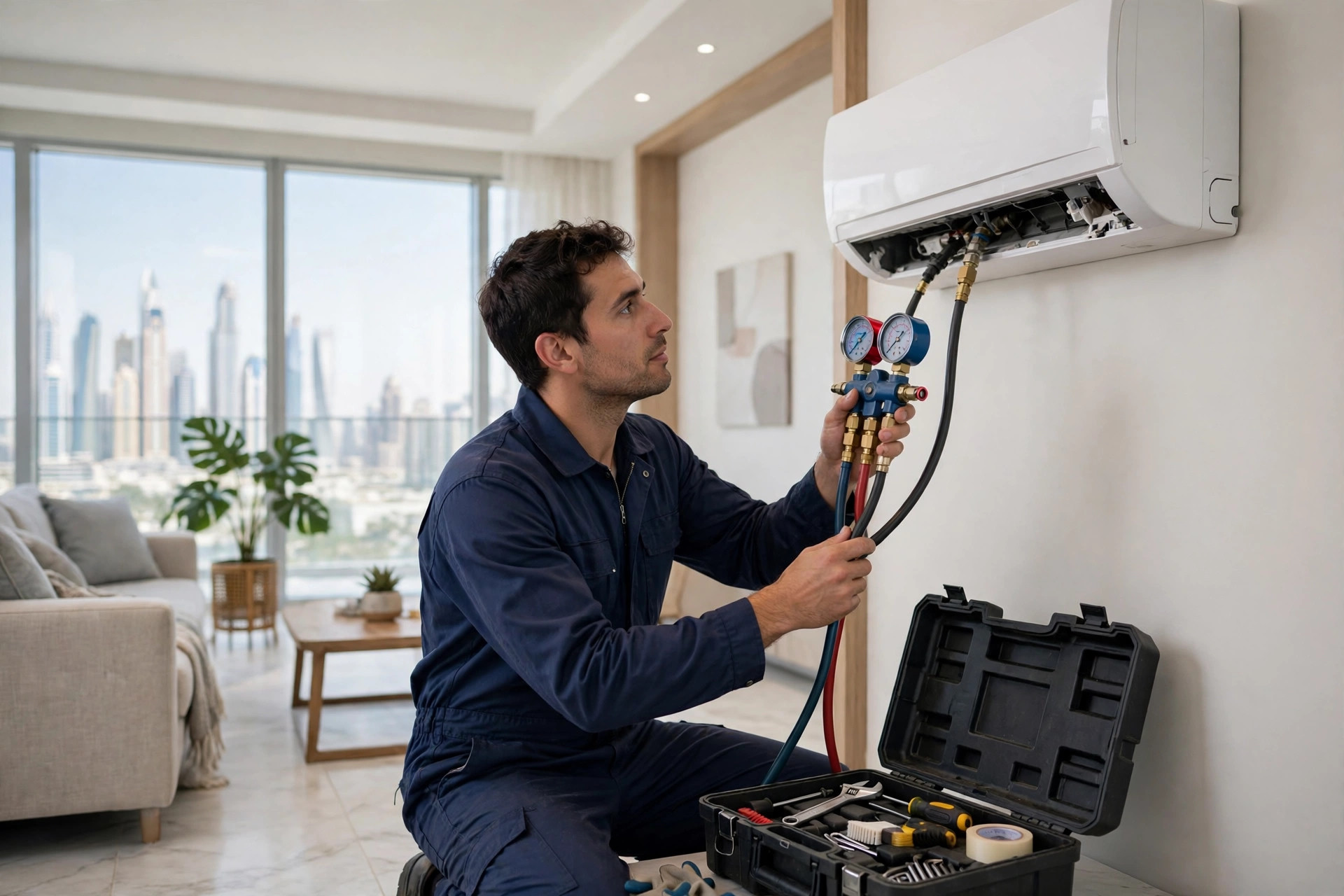
In Abu Dhabi, an air conditioner is not a luxury — it is the machine that makes the city liveable. From late spring to early autumn, your AC runs up to twenty-four hours a day, pulling humid Gulf air through its filters and cooling it. That workload is unlike anywhere else, and it is why AC trouble here rarely arrives politely: one evening the bedroom feels warm, the next morning the unit is dripping water onto the floor or refusing to start at all.
This guide is written the way a good technician talks: plainly, with the causes first and the sales pitch nowhere in sight. It covers the faults Abu Dhabi homeowners actually meet, what you can safely check yourself, when repair is the right call, when replacement makes more sense, and what a professional visit should look like — diagnosis first, clear pricing before any work begins.
Why Abu Dhabi Is Hard on Air Conditioners
Three things wear an AC down in the capital faster than in cooler climates: heat, dust and humidity. Outdoor condenser units sit in direct sun on balconies and rooftops, where summer temperatures push past 45°C. Fine desert dust coats condenser coils and clogs filters, forcing the compressor to work harder for the same cooling. And humidity — often above 60% even on a clear day — means the drain system is constantly moving condensed water out of your home. A blocked drain here is not a minor nuisance; it is a leak waiting to happen.
Add continuous use: an AC that runs almost all year never rests, so small problems — a slow refrigerant leak, a wearing fan motor — compound quietly until the system gives up. The most valuable habit here is noticing the early signs while the fix is still small.
The 5 Most Common AC Problems — and What They Mean
1. Weak cooling: the room never quite gets cold
The unit runs, the fan blows, but the air is lukewarm and the thermostat never reaches its set point. The usual suspects: a dirty filter or evaporator coil choking airflow, low refrigerant from a slow leak, or a condenser coil caked in dust so it cannot shed heat outside. Check the filter first — hold it up to the light, and if you cannot see through it, wash or replace it. If the filter is clean and the problem persists, do not keep running the unit at its coldest setting: that only ices the coil and strains the compressor. A technician needs to measure refrigerant pressure, because a gas top-up without finding the leak is money spent twice.
2. Water leaking inside the room
Water dripping from the indoor unit is almost always a drainage problem: a blocked condensate drain, a cracked drain pan, or a unit that has shifted slightly out of level. In Abu Dhabi’s humidity, a blocked drain can spill litres in a day — onto wooden floors, into ceilings and down walls, where the damage costs far more than the repair. Switch the unit off and do not ignore it. A drain flush is one of the cheapest professional fixes there is — but only before the water reaches your plasterwork.

3. Strange noises: rattling, buzzing, hissing
Your AC should hum, not complain. Rattling often means a loose panel, a fan blade touching its housing, or debris caught in the outdoor unit. Buzzing can point to an electrical fault — a failing capacitor or a loose connection — and should never be left to “settle down”. Hissing, especially near the indoor unit, can indicate a refrigerant leak. Note when the noise starts — at switch-on, during cooling, or only when the fan speed changes — it helps a technician diagnose the fault in minutes.
4. The AC trips the breaker — or will not start at all
A breaker that trips the moment the AC starts is usually protecting you from a genuine fault: a shorted compressor, a failed capacitor, or damaged wiring. Resetting the breaker and trying again is reasonable once. If it trips a second time, stop — repeated resets risk burning out the compressor, which turns a modest repair into a major one. The same applies to an AC that will not start at all. Check the remote batteries, the thermostat setting and the isolator switch first; beyond that, the fault is electrical, and electrical faults are the one category where do-it-yourself is never worth it. If your home has other electrical issues — flickering lights, warm sockets, frequent tripping — read our guide to an electrician in Abu Dhabi first.
5. Ice on the indoor unit
Ice on the coils looks dramatic, but the cause is usually simple: restricted airflow from a dirty filter, or low refrigerant. Switch the unit to fan-only mode and let the ice melt fully — never chip it off. Then check the filter. If the ice returns, the refrigerant charge needs measuring. Running an iced-up unit is one of the fastest ways to damage a compressor.
Repair or Replace? The Honest Answer
Every AC reaches a point where repair stops making sense, and a trustworthy technician will say so. Two rules of thumb help. First, age: the Dubai Electricity and Water Authority notes that the optimal lifetime of an AC is around ten years, and that replacing an old unit with a modern energy-efficient model carrying a 4- or 5-star ESMA rating can save up to 25% on cooling consumption. If your unit is past a decade, needs a major part, and still cools poorly, replacement deserves a serious look. Second, frequency: one repair a year is maintenance. Three repairs in one summer is a system telling you it is done. Most faults in units under eight years old — a capacitor, a fan motor, a drain fix, a sensor — are worth repairing. The decision should always rest on a diagnosis, not a guess, and any quote given without inspecting the unit should be treated with caution.
What a Professional AC Repair Visit Should Look Like
A proper visit follows a sequence. First, the technician listens: what is the symptom, when did it start, has it happened before? Then comes inspection — filters, coils, drain, refrigerant pressure, electrical connections, thermostat. Only then a diagnosis, explained in plain words, with the price agreed before work starts. That is the diagnosis-first approach we follow at Abu Dhabi Home Repair: transparent pricing, verified technicians, and no work without your say-so. After the repair, the unit should be tested through a full cooling cycle, not just switched on for thirty seconds.
Keeping Your AC Healthy Between Visits
Most of Abu Dhabi’s AC breakdowns are preventable: clean the filters every two to four weeks in summer, keep the outdoor unit clear of dust, and book a professional service before the peak heat arrives — not in the middle of it, when every technician in the city is booked solid.
Set the thermostat wisely, too. DEWA’s guidance is to keep it at 24°C or higher, because each degree you raise the setting can save up to 5% on AC consumption. In Abu Dhabi the same physics applies, and Abu Dhabi Distribution Co.’s energy-friendly air conditioning advice notes that cooling accounts for around 70% of summer peak electricity load — so a well-maintained AC is not just comfortable, it is cheaper to run. The UAE government also runs an efficiency-labelling scheme for split-unit air conditioners, covered on the official UAE Government portal’s energy efficiency page — worth checking before you buy a replacement unit.
One more practical note for travellers: if you are heading away for a holiday, get the AC serviced before you go, not after you return to a hot, humid flat. And if you are still planning the trip itself, UAE Travel Brief has practical UAE travel guides worth a read alongside your packing list — a little planning before you leave saves a lot of discomfort when you come home.
When to Call the Same Day
Some AC problems can wait a day. These cannot: water leaking into ceilings or walls, a burning smell, a breaker that keeps tripping, a complete failure during a heatwave, or any fault in a home with an infant, an elderly person, or someone with a health condition. In those cases, same-day service is not a convenience — it is the right call, and it is what we offer across Abu Dhabi. You can book a same-day AC repair visit, call (056) 3475221 or email help@abudhabihomerepair.com and describe the symptom; the more detail you give, the faster the fix.
Your home’s systems are connected, too. A leaking AC drain and a blocked bathroom drain often arrive together in older villas — our guide to a plumber in Abu Dhabi covers the plumbing side — and a full refresh, from a handyman in Abu Dhabi to a struggling fridge, is often best handled in one visit. If your fridge repair in Abu Dhabi is also due, mention it when you book — the same goes for the washing machine drum, the dishwasher and the oven.
Frequently Asked Questions
How fast can an AC repair be done in Abu Dhabi?
Most common faults — filters, drains, capacitors, sensors — are diagnosed and fixed in a single same-day visit. Major part replacements may need a follow-up visit if the part has to be sourced.
Why is my AC running but not cooling?
Usually a dirty filter or coil, low refrigerant from a leak, or a dust-clogged outdoor condenser. Check and clean the filter first; if that does not fix it, the refrigerant pressure needs a professional check.
Is it safe to keep using an AC that leaks water?
No. Switch it off and call a technician the same day — a blocked drain can spill a lot of water quickly, and the damage costs far more than the drain fix.
My AC is over ten years old and keeps breaking down. Repair or replace?
Get a diagnosis first, then weigh repair cost against age and efficiency. As DEWA notes, a modern 4- or 5-star ESMA-rated unit can cut cooling consumption by up to 25%.
Related Reading: Home Washer Fixing Service in Abu Dhabi
