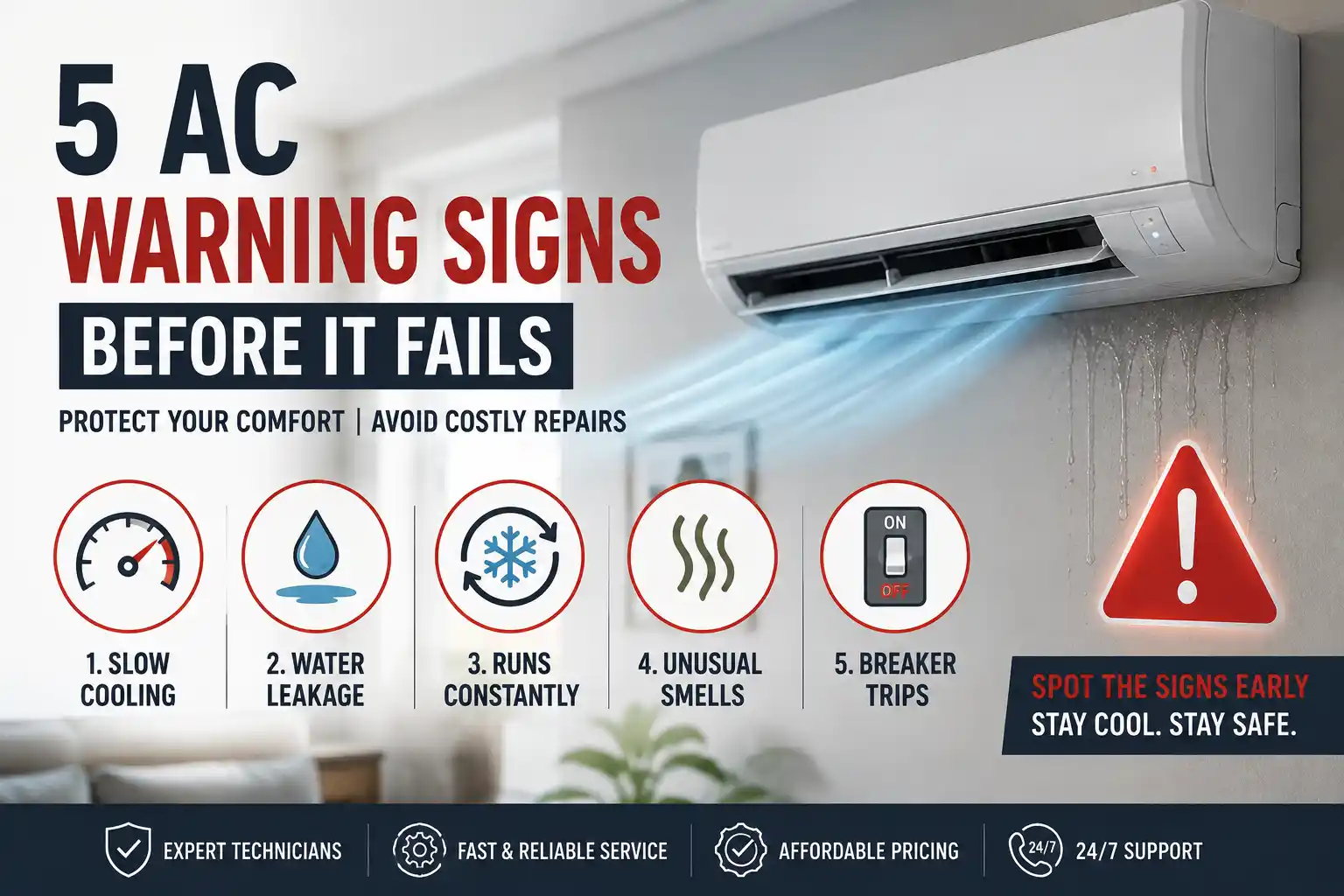
AC Warning Signs Before It Fails_ Almost nobody’s air conditioner fails without notice. It fails on the hottest Thursday of the year, at 9pm, with guests in the house — and that feels sudden. But if you go back through the previous month, the unit was already telling you. It was just saying it quietly, in ways that are easy to write off as “the weather.”
In the UAE that matters more than almost anywhere. Our summer runs five months, daytime temperatures sit past 45°C for weeks at a stretch, and a domestic split unit is doing work it was never really designed for. Cooling is the single largest line on a UAE household’s summer electricity bill, and the machine producing it runs sixteen to twenty hours a day from May to September. Under that load, small faults do not stay small.
If you’re already noticing unusual cooling behaviour, it’s worth arranging an AC repair service in Abu Dhabi before a minor issue develops into a major breakdown.
Here are the five warnings that come first, roughly in the order homeowners tend to notice them.
The Room Takes Longer to Cool Than It Did Last Month
This is the earliest signal and the most ignored, because it is gradual. In May the bedroom hit 22°C in fifteen minutes. By July it takes forty. You assume it is because July is hotter than May. Some of that is true. Most of it is not.
A slow-cooling room almost always means one of two things: airflow is restricted, or refrigerant charge has dropped. Restricted airflow is the cheap version — clogged filters, a dirty evaporator coil, a blocked outdoor condenser. Low refrigerant is the expensive version, because refrigerant does not get “used up.” A system that is low on gas has a leak somewhere, and topping it up without finding the leak means paying for the same repair three times.

If you’re unsure whether poor cooling is coming from airflow, refrigerant or another component, a professional AC cooling issue inspection can help identify the actual cause instead of simply adding gas and hoping the problem disappears.
The test is simple. Hold a thermometer at the supply grille, then at the return. A healthy split system should show a difference of roughly 8–12°C between air going in and air coming out. Under 6°C, something is wrong.
Water Appearing Where Water Should Not Be
A wet patch on the wall under the indoor unit, or a drip from the fascia, means the condensate drain is blocked. In UAE homes this is one of the most common faults and one of the most damaging, because the leak rarely stays cosmetic. Water tracks along the wall cavity, lifts skirting, blooms into mould behind furniture, and by the time it is visible on the paint it has usually been running for weeks.
The blockage itself is often a five-minute job — a flush of the drain line. The wall repair afterwards is not. This is the fault where waiting genuinely costs you money.
If moisture has already damaged the surrounding surface, dealing with the underlying leak should come first. For broader household water issues, you can also review the water leak repair service options available for residential properties.
The Unit Runs Constantly and Never Reaches the Set Temperature
If the compressor never cycles off, the system has lost the capacity to satisfy the thermostat. It will keep running because it is trying, and it will keep drawing full current while it does.
There is a fault behind this — usually a failing capacitor, a compressor losing efficiency, or a serious refrigerant shortfall. But there is also a bill behind it. A unit that runs 24 hours instead of cycling for 14 can add several hundred dirhams a month to a villa’s electricity cost. People often discover this fault through DEWA or ADDC rather than through discomfort: the bill jumps, and nothing in the household changed.
A thermostat that is inaccurate or failing can also cause unusual cycling and temperature problems. If the thermostat itself appears unreliable, it’s worth checking the causes covered in this guide to an AC thermostat that isn’t working correctly.
Smell–AC Warning Signs Before It Fails
Two smells matter, and they mean very different things.
A musty, damp, “wet towel” smell when the unit starts up is biological growth on the evaporator coil and in the drain pan. It is unpleasant, it is a genuine indoor-air-quality issue in a house with children or anyone asthmatic, and it is fixed by a proper coil clean rather than an air freshener.
A sharp chemical or burning-plastic smell is different, and it is not a maintenance issue. Switch the unit off at the isolator and call someone. Electrical faults in AC units are the origin of a meaningful share of residential fires in hot climates, and the burning smell is the last warning you get before that becomes a real possibility.
Don’t keep resetting or operating a unit that produces a persistent burning smell. Electrical inspection may be necessary, particularly if the problem is accompanied by breaker trips or unusual sounds.
The Breaker Trips
An AC circuit that trips once might be coincidence. An AC circuit that trips twice is a fault, and resetting it repeatedly is the wrong response. The breaker is doing its job — something downstream is drawing more current than the circuit is rated for, and the usual causes are a seizing compressor, a failing fan motor, or degraded wiring at the outdoor unit where sun and heat have made the insulation brittle.
If the breaker keeps tripping specifically when the AC starts or under heavy cooling demand, the issue should be investigated rather than treated as a simple electrical nuisance. A dedicated AC breaker tripping inspection can help identify whether the problem is connected to the unit, wiring or another component.
Nobody should be resetting the same breaker three times in a week. That is the point at which the machine stops being an inconvenience and starts being a hazard.
What a Fair Repair Quote Actually Looks Like in the UAE?_ AC Warning Signs Before It Fails
This is where most homeowners feel out of their depth, and where the market takes advantage. Two things protect you.
The first is knowing the going rates. UAE pricing is more consistent than people assume: a diagnostic call-out generally sits somewhere between AED 150 and AED 300, a standard service visit on a split unit lands in a similar band, gas refills range from roughly AED 150 to AED 450 depending on system size and refrigerant type, and annual maintenance contracts typically start around AED 500 per unit per year. Rates differ a little between emirates — AC service in Dubai tends to run marginally above Abu Dhabi on labour, and marginally below on parts — but not dramatically.
Before booking, it’s also useful to compare the expected work against an appliance repair cost breakdown or other local repair pricing information. The exact price will always depend on the fault, model, parts and amount of labour required.
Dubai operators such as AC Pro Dubai publish their call-out and service bands openly rather than quoting blind, and a company willing to put numbers on a public page before it has seen your unit is generally a company that will not invent numbers after it has.
The second is insisting on an itemised written quote before any work starts. Parts, labour, refrigerant and call-out listed separately. The single most common complaint in UAE home services is not that the price was high — it is that the price was one number, delivered verbally, that grew once the technician was already inside. An itemised quote makes that impossible.
Two more things worth asking for: a written workmanship warranty (90 days is a reasonable benchmark for repairs and installations, and a firm that will not offer one is telling you something), and confirmation that the technician is working under a licensed, insured company rather than as an informal subcontractor. In an apartment building, an uninsured technician causing a water leak into the unit below becomes your problem, not theirs.
The Maintenance Schedule That Actually Prevents All of This
Almost every fault above is preventable, and the prevention is unglamorous.
Filters should be washed monthly through the summer — this is a homeowner job, it takes ten minutes, and it does more for cooling performance than anything else on this list. Coils, both indoor and outdoor, need a professional clean twice a year, ideally in March before the season starts and again in September after the worst of it. Drain lines should be flushed at every service visit. Refrigerant pressures and electrical connections should be checked annually.
For more detailed preventive work, a professional HVAC inspection and preventive maintenance service can identify problems before they turn into emergency repairs.
For most UAE homes that means two professional visits a year, not four, and not one. One visit is not enough for a system running twenty hours a day in 45°C heat. Four is usually a contract padded to look busy.
If your system is already struggling and you need a faster assessment, an AC quick-fix service may be appropriate for straightforward faults, while more complex compressor, electrical or refrigerant problems may require a full diagnostic visit.
The households that never have an August emergency are almost never the ones with the newest equipment. They are the ones who booked the March service.
Related Reading: AC Plenum Box Sealing — full guide
Related Reading: AC Refrigerant Overcharge Symptom — full guide
