A cooker hood that stops pulling smoke turns the whole kitchen into a steam room — and in an Abu Dhabi home, where the hob runs most days and the windows stay shut against the heat, there is nowhere for that smoke to go. If you are settling into life in the capital, UAE Travel Brief is a handy first read on how things work here; this guide stays on the cooker hood itself: the faults Abu Dhabi technicians see most, the few checks that are safe to do yourself, and when a repair is worth the money.
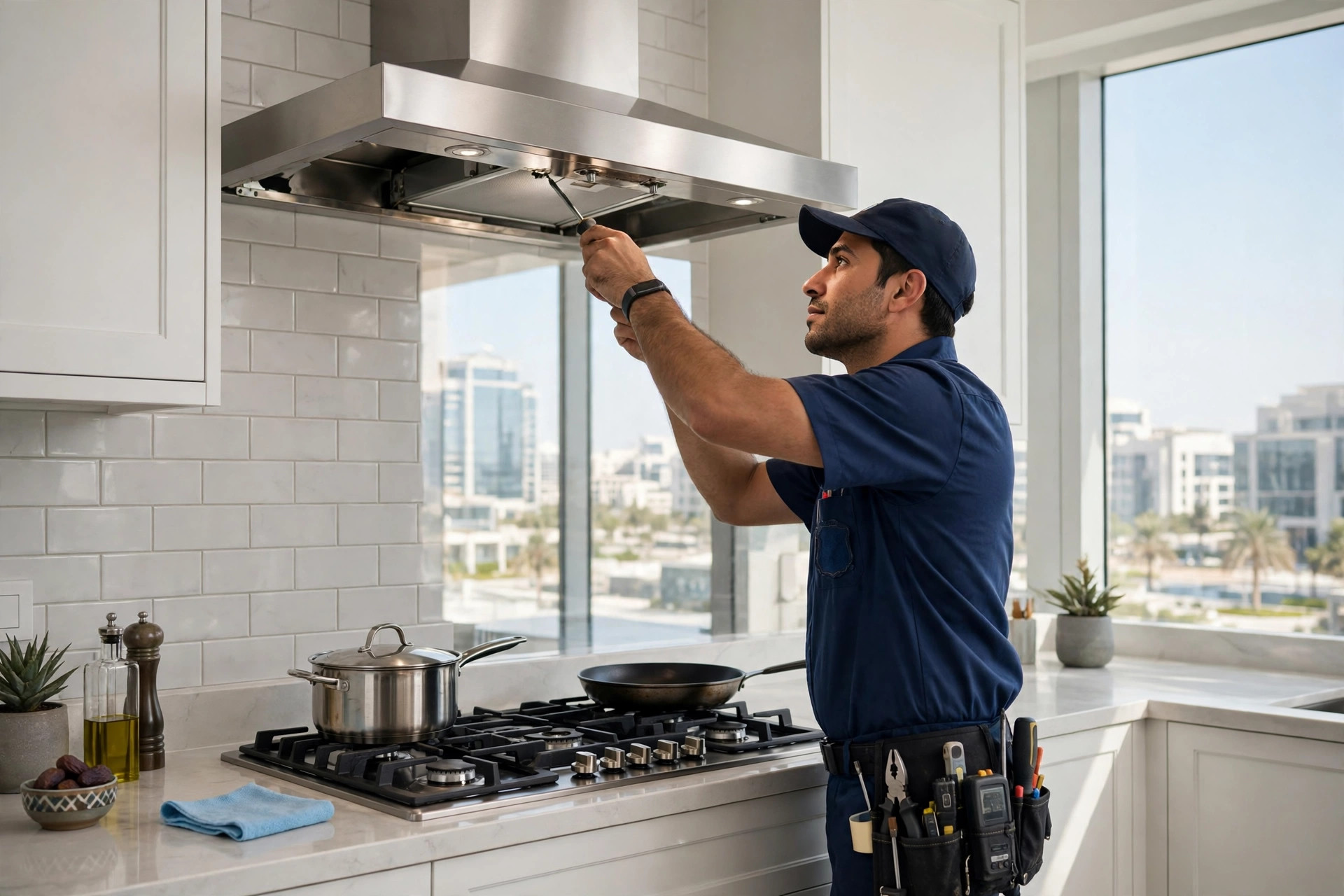
The faults that bring cooker hoods in
Most cooker hood call-outs fall into six patterns. The most common is weak suction — the hood runs, the fan spins, but the smoke from the pan drifts straight past it and into the room. That almost always points to grease-clogged filters, a blocked duct, or a fan that has lost power over time. A hood that cannot move air is doing nothing at all, and it is the fault people live with longest because the motor still makes noise.
Second is a hood that has become noisy. A low hum is normal; a rattling, grinding or whining sound is not. It usually means a worn fan motor bearing, a loose fan blade, or grease and dust built up inside the fan housing. A noisy hood is often a hood heading for a dead motor, and catching it early is the difference between a cleaning and a motor replacement.
Third is a fan that does not start at all. Sometimes the whole hood is dead — no lights, no fan, nothing — which usually means a power problem, a failed control board or a burnt-out motor. Sometimes only one speed works, or the fan starts and then stops after a few seconds. Those are control and motor faults, and they need a technician with the right parts, not a guess.
Fourth is lights that stop working. Cooker hood lights fail often because they sit directly above the heat and the steam. Usually it is just the bulbs — but if new bulbs do not fix it, the fault is in the lamp holder, the wiring or the switch, and it is worth having checked properly rather than lived with in a dark kitchen.
Fifth is grease and smell that will not go away. A hood can be running perfectly and still leave the kitchen smelling of last night’s cooking if the grease filters are saturated or the carbon filters in a recirculating hood are long past their life. Grease is also a fire risk when it builds up inside the hood and the duct, which is why a hood that has never been deep-cleaned deserves attention even when it still “works”.
Sixth is a control panel that stops responding — touch buttons that do nothing, a display that flickers, or a hood that turns itself on and off. These are usually control-board faults, sometimes made worse by steam getting into the electronics over months of cooking.
What you can safely check yourself
There are only a few checks that are genuinely safe, and they are worth doing before you call anyone.
First, look at the filters. Slide out the metal mesh grease filters under the hood and hold them up to the light. If you cannot see through them, they are clogged — and a clogged filter is the single most common cause of weak suction. Most metal filters can be soaked in hot water with dish soap, or run through the dishwasher. Let them dry fully before putting them back.
Second, confirm the power properly. Check that the hood is switched on at the wall and that nothing has tripped. Cooker hoods sometimes share a circuit with the oven, and a tripped breaker can leave the hood dead while everything else in the kitchen works.
Third, check the fan speed. Many hoods sit on the lowest speed for months because nobody changed it. Turn it up to the highest setting while you cook and see whether the smoke clears. If the highest speed still does nothing, the problem is in the filters, the duct or the motor — not the setting.
Fourth, look at the duct outlet if you can reach it safely. On a ducted hood, the air has to go somewhere — usually out through a wall or the roof. A flap or grille blocked by dust, a bird’s nest or building work will strangle the airflow no matter how well the motor runs. Do not climb onto the roof or open the ducting yourself; note what you can see and tell the technician.
Everything else — opening the hood casing, touching the motor wiring, replacing the control board — is a technician’s job. A cooker hood sits above a hot hob and works on mains power; that combination is not a DIY project.
Ducted or recirculating: the repair is different
Abu Dhabi kitchens have both kinds, and the repair is different for each. A ducted hood pushes the air outside through a duct. When it fails, the fault is usually in the filters, the fan or the duct itself — a blockage, a collapsed section of ducting, or a fan that can no longer push against the length of the run. A good repair visit checks the whole air path, not just the motor, because a new motor on a blocked duct is a repair that comes back.
A recirculating hood has no duct. It cleans the air through grease filters and carbon filters, then blows it back into the kitchen. When it stops working, the carbon filters are the first suspect — they absorb smells for a few months and then stop working entirely. Many households never change them, because the hood keeps running and nobody notices the smell creeping back. A repair visit for a recirculating hood should always include a filter check, and the technician should tell you honestly how often the carbon filters need replacing in your kitchen.
If you are choosing a replacement, ask which kind your kitchen actually has. A ducted hood fitted where there is no duct, or a recirculating hood sold as if it vents outside, is a mismatch that no repair can fix.
What a proper cooker hood service includes
A proper service is more than wiping the outside. The technician removes and cleans the grease filters, checks the fan and motor for wear, tests every speed, checks the lights and the control panel, and inspects the duct or the carbon filters depending on the type. On a ducted hood, the duct run is checked for blockages. On a recirculating hood, the carbon filters are checked and replaced if they are spent.
That is the same approach we take on our Kitchen Hood Repair service — diagnosis first, then the repair, with the price told to you before any work begins.
How the visit works
The honest answer about cost is that it follows the fault. A filter clean, a bulb, a fan blade or a carbon filter change are all small jobs. A fan motor or a control board costs considerably more, and on an older hood the repair can approach the price of a new unit. That is exactly the conversation a diagnosis-first visit is for: the technician finds the fault, tells you the price of the part in plain terms, and you decide with real numbers in front of you.
That is how we work at Abu Dhabi Home Repair — diagnosis first, transparent pricing, no charge for guessing. Most common faults are fixed in a single visit once diagnosed, and same-day service is available across Abu Dhabi — from villas in Khalifa City, Mohammed Bin Zayed City and Al Reef to apartments on the Corniche, Al Reem Island and Al Maryah Island. If your other appliances are playing up too, our guides follow the same approach: our Washing Machine Repair Abu Dhabi guide covers the laundry faults that most often appear in the same homes, and our Oven Repair Abu Dhabi guide covers the kitchen side, including the ovens that share a circuit with the hood.
How to make a cooker hood last longer
A few habits add years to a cooker hood. Clean the metal grease filters every month — in a kitchen that cooks daily, every two weeks is better. Run the hood for a few minutes after you finish cooking so the last of the steam and grease clears the duct instead of settling inside it. Use the right fan speed for what you are cooking: low for simmering, high for frying. Replace carbon filters on schedule if your hood recirculates. And wipe the underside of the hood regularly, because the grease that collects there is what eventually finds its way into the fan.
In a city where the hob runs most days of the year, those small habits are the difference between a hood that lasts three years and one that lasts ten.
FAQ
My cooker hood runs but the smoke stays in the kitchen. What is wrong?
Most often the grease filters are clogged, the duct is blocked, or the fan has lost power. Clean the filters first — if the suction does not come back, the duct or the motor needs a technician.
The hood has become very noisy. Should I worry?
Yes — a rattling or grinding sound usually means a worn motor bearing or a loose fan blade. It often gets worse quickly, so get it checked before the motor fails completely.
How often should I clean the grease filters?
Every month in a kitchen that cooks daily, every two weeks if you fry often. Hold them up to the light — if you cannot see through them, they are overdue.
My hood has no duct. Do I still need to change anything?
Yes — the carbon filters. They absorb cooking smells for a few months and then stop working. A recirculating hood with spent carbon filters will run and do almost nothing.
The lights stopped working but the fan still runs. Is it a big repair?
Usually not — it is often just the bulbs. If new bulbs do not fix it, the fault is in the holder, the wiring or the switch, and a technician can sort it in the same visit.
How quickly can a cooker hood be repaired in Abu Dhabi?
Most common faults are fixed in a single visit once diagnosed. Same-day service is available from Abu Dhabi Home Repair — call (056) 3475221 or email help@abudhabihomerepair.com to book a diagnosis-first visit.